
Washer Not Draining or Spinning? How to Fix It and When to Call a Technician in Santa Clarita
Updated , by Fix Time
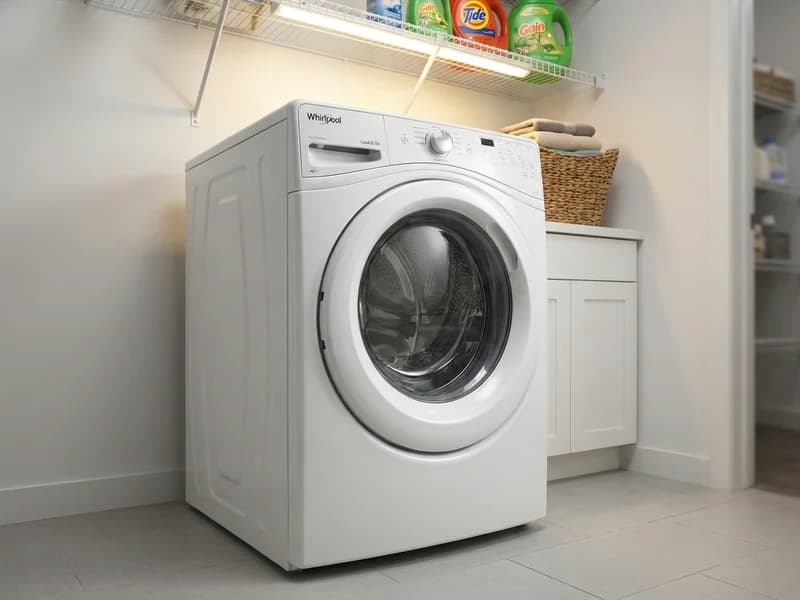
You open the lid or look through the door and the drum is still full of gray water. Or the washer drained, but the clothes are soaking wet because the spin never happened. A washer not draining and a washer not spinning come from the same short list of causes, and in a lot of cases the fix is a hose, a filter or the load itself, not a broken part.
This guide covers what to check first, in the order that saves the most time, what the error codes on the display mean, how the water in Santa Clarita and the San Fernando Valley plays into it, what a repair costs in 2026, and when to stop and call a technician. Every figure comes from a manufacturer, a water agency or a published cost survey, with the source linked.
Why a washer is not draining or spinning
A washer does not spin a drum full of water. Samsung puts it plainly in its own troubleshooting guide: before the washer spins, it tries to drain, and if it is unable to drain, it never moves to the spin step. So "won't spin" is often a drain problem in disguise, and the drain side is where to start.
The reverse also happens. A washer can drain fine and still refuse to spin because it thinks the load is unbalanced, because the lid or door is not reported as locked, or because suds are holding the drum back. The checks below cover both paths.
One thing to rule out before anything else: a short pause is normal. GE notes that on many models pauses of up to 3 minutes between cycles are normal. Give the washer a few minutes before you start taking things apart.
Before you touch anything: unplug it and get the water out
Unplug the washer or switch off its breaker before you open any panel or filter cover. LG's maintenance instructions start with exactly that step, and LG also warns that the water remaining in the washer may be hot and can cause burns. If you just ran Sanitize or a hot wash, wait about an hour.
Front-load washer. The door stays locked while there is water inside, so you drain it from the bottom front. Behind a small access panel you will find the pump filter and, on many models, a thin drain tube with a plug. Lay towels on the floor and set a shallow pan in front, as LG and GE recommend, since the opening sits close to the floor. Pull the tube out, remove the plug and let the water run into the pan; close the plug, empty the pan and repeat. Samsung suggests a container large enough for the amount of water in the washer, like an oil drain pan. Once the flow stops, turn the pump filter counterclockwise and pull it out slowly, as GE's filter instructions describe.
Top-load washer. Check your manual before looking for a filter: Samsung, for example, states that its top-load washers do not have a pump filter. Bail the water out with a container into a bucket or tub, then move on to the hose and the load checks below.
Seven checks before you call
1. Look at the load
Start with the laundry itself. A washer that senses a lopsided load slows down or stops the spin to protect itself; Whirlpool lists a load that is too heavy or unevenly distributed among the first causes. Too little laundry does the same: one bath mat, comforter or pair of jeans can end up on one side of the drum. Spread the load out, add a couple of towels to a single heavy item, and restart.
Also check the cycle. Gentle, delicate and hand-wash cycles spin slowly on purpose, and slow spinning leaves more water in the load. Wet clothes after a delicate cycle are not a fault.
2. Check the lid or the door
Washers will not spin unless the lid or door is detected as closed and locked. On a front-loader, look for a sock or towel caught between the door and the rubber gasket. On a top-loader, make sure nothing is propping the lid. GE washers show dE or E2 when the lid has been opened mid-cycle, and LG front-loaders show dE when the door could not lock.
3. Rule out suds
Too much detergent, or regular detergent in a high-efficiency washer, makes enough foam to stop the pump and slow the spin. If you see foam through the door or in the tub, run a rinse with no detergent, then use only HE detergent at the dose printed on the bottle.
4. Inspect the drain hose
Pull the washer out a few inches and follow the gray hose from the back of the machine to the drain. Look for a kink where it bends behind the washer, a crushed section, or lint packed into the end. Whirlpool's guide lists a kinked or clogged drain hose, drainpipe or utility sink among the first things to check.
5. Check how the hose sits in the standpipe
This check matters in both directions. A hose pushed too deep into the drain pipe, or sealed into it with tape, can siphon water out of the washer during the cycle; a drain that sits too low does the same by gravity. Three things to look at:
- Depth. The hose end should sit only a few inches inside the pipe. The limit is 4.5 inches on Whirlpool washers and 8 inches on LG, so if yours goes deeper than that, pull it up.
- Height. The top of the drain pipe usually needs to be roughly 30 to 96 inches off the floor. Some top-loaders ask for 39 inches and some front-loaders allow less, so your installation manual has the final word.
- Air gap. Never tape or seal the hose into the pipe. LG warns against an airtight seal between the hose and the drain: the gap around the hose is what stops water from being pulled back out.
If your washer fills and drains at the same time, or the drum never seems to hold water, look at the hose first: Whirlpool notes that drained water can siphon back into the washer if the drain hose extends too far.
6. Clean the pump filter (front-loaders)
The pump filter is a coin trap: it catches coins, hairpins and lint before they reach the pump, and both LG and Samsung recommend cleaning it about once a month. Rinse it under the tap, check the opening for anything stuck, and screw it back in clockwise until it stops. A filter that was packed full is often the whole problem.
7. Find out whether the clog is in the washer or the house
LG describes a simple test: take the drain hose out of the house drain, put its end in a bucket or tub, and run a spin-only cycle; if water drains normally from the hose, the washer is operating properly. If the washer pumps out fine but the standpipe overflows, or a nearby sink gurgles and backs up, the clog is in your plumbing and a plumber is the right call, not an appliance technician.
What the codes on the display mean
Most modern washers report drain and spin problems with a code. A few common ones:
- Samsung: 5C, 5E, SC or nd means the washer is not draining; UE or Ub means an unbalanced load; dC or dE means the door is not locked. Samsung's own error code list explains each one, and our Samsung washer repair page walks through them with what to try.
- LG: OE means not draining (LG names a clogged filter, a kinked hose or a frozen hose); UE is an unbalanced load, shown as uE while the washer is still retrying; dE is a door lock problem.
- GE: on 2015 and newer models, a flashing Rinse light or "Po" scrolling on the display can mean a clog in the drain path.
A code that disappears after you fix the load, the hose or the filter was doing its job. A code that comes back after every check is pointing at a part.
The water in Santa Clarita and the San Fernando Valley
Water hardness varies a lot across the area this guide covers. In SCV Water's 2026 Consumer Confidence Report, covering 2025, hardness averaged 160 mg/L in imported surface water and 354 mg/L in local groundwater, and 355 mg/L in Los Angeles County Waterworks District 36. SCV Water notes that the hard water many residents experience comes from minerals in the groundwater supply, not from contaminants, so homes across Valencia, Saugus, Canyon Country and Newhall can see very different readings. In the San Fernando Valley, LADWP's 2026 water quality report lists averages of 103 to 140 mg/L for the three sources that serve the valley. By the USGS classification, anything over 120 mg/L is hard and over 180 is very hard.
Two practical consequences. First, hard water calls for more detergent, as the USGS notes, but in an HE washer the answer is the hard-water dose printed on the bottle, not an extra scoop; more than that brings back the suds problem from check 3. Second, minerals collect in the small screens where the supply hoses connect, and LG notes these inlet filters can become clogged, especially in areas with hard water. That shows up as slow filling rather than slow draining, but it is worth checking on the same visit behind the machine.
Parts that fail when the checks come up clean
If the load, door, detergent, hose, filter and house drain all check out, one of these parts is usually involved:
- Drain pump. It hums but moves no water, or stays silent.
- Lid switch or door lock. A cost guide from HomeGuide sums up the symptom well: top-load washers run without spinning or draining when the lid switch breaks, and front-load washers will not run with a broken door lock.
- Clutch or shifter on many top-loaders. The washer fills and agitates but never switches into spin.
- Motor or motor control. Samsung notes that a washer that does not spin at all may need service for a motor issue.
- Control board. Diagnosed only after the parts above are ruled out.
What washer repair costs in 2026
National cost guides give these ranges:
- Typical washer repair: $180 to $250, average $220, according to Angi's 2026 cost data; HomeGuide puts the overall range at $100 to $400.
- Drain pump replacement: $150 to $400 (Angi) or $150 to $350 (HomeGuide).
- Lid switch or door lock: $75 to $200 (Angi) or $100 to $300 (HomeGuide).
For homes in Santa Clarita and the San Fernando Valley, the Fix Time service call is $75 and it is credited toward the repair. The technician diagnoses the washer first and gives you the repair price before any work begins, so you decide with a real number in hand. Call us for a quote on your model.
Repair or replace?
A washing machine lasts 8 to 13 years on average, according to HomeGuide; the National Association of Home Builders' life-expectancy study put it at about 10. Angi's rule of thumb is to replace the washer when the repair would cost more than half the price of a new one.
HomeGuide suggests a repair is usually worth it when the washer is less than 7 years old, the repair costs less than half the price of a new one, or the warranty is still valid. On an older washer, a motor or transmission repair can approach the price of a new machine, so get the quote first, and check whether a long manufacturer parts warranty still covers the motor. If you do replace, ENERGY STAR certified washers use about 20% less energy and 30% less water than standard models, and front-loaders use about half the energy and water of a top-load agitator washer.
When to call a technician
Call when the same problem returns after the seven checks, when the pump hums but no water moves, when a top-loader agitates but never spins, when you see water on the floor, or when you smell burning. In the last two cases, unplug the washer and do not run it again until it has been looked at.
Fix Time repairs washers of every major brand at your home across Santa Clarita, Valencia, Stevenson Ranch, Castaic, Canyon Country and the San Fernando Valley, from Northridge and Granada Hills to Sherman Oaks and Burbank. The washer repair page lists the brands and faults we handle, LG appliance repair and Whirlpool appliance repair cover those brands, and the Santa Clarita appliance repair page shows the neighborhoods we serve.
Call us at (909) 698-8788 or book a repair online. Have the model number ready, usually on a sticker inside the door or lid, or on the back panel: it lets the technician bring the right pump, switch or door lock on the first trip.
Frequently asked questions
Why is my washer not draining?
The usual causes are a clogged drain pump filter on a front-loader, a kinked or blocked drain hose, a drain hose pushed too far into the standpipe, too many suds from the wrong detergent, and a clog in the house drain rather than the washer. If all of those check out and the washer still holds water, the drain pump or its control is the likely fault and needs a technician.
Why won't my washer spin even though the water drained?
Check the load first: an unbalanced, overloaded or very small load stops the spin on purpose. Then check for a lid or door that the washer does not detect as locked, too many suds, and a gentle or delicate cycle that spins slowly by design. Spread the load evenly, check the door, use HE detergent and run a spin-only cycle. If the drum still will not spin, the lid switch, door lock, motor or, on many top-loaders, the clutch needs a diagnosis.
How do I drain a front-load washer that is full of water?
Unplug it, put towels on the floor and a shallow pan in front of the access panel at the bottom front. Pull out the small drain tube next to the pump filter, remove its plug and let the water run into the pan, emptying it as it fills. Then turn the pump filter counterclockwise to remove it and clean it. If you just ran a hot cycle, wait about an hour for the water to cool.
How far should a washer drain hose go into the standpipe?
It depends on the brand: Whirlpool allows no more than 4.5 inches, GE says 5 to 7 inches, LG no more than 8 inches and Samsung 6 to 8 inches. Every brand warns against an airtight seal, because a hose that goes too deep or fits too snugly can siphon water out of the washer. Check the installation manual for your model.
How much does it cost to fix a washer that won't drain?
National cost guides put a drain pump replacement at about $150 to $400 and a lid switch or door lock at about $75 to $300, depending on the source and the model. Fix Time charges a $75 service call that is credited toward the repair, and you get the repair price before any work begins.